
Past Exhibitions
Louisa Waber: Recent Painting and Drawing
Saturday, February 4 - Sunday, March 19, 2017
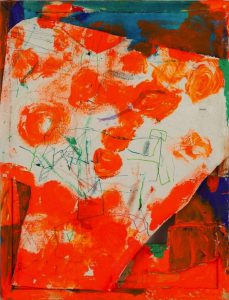
Louisa Waber, Untitled, 2015, Acrylic and ink on canvas, 21″ x 16″
Waber mentions Cezanne, Hofmann, de Kooning, and Guston, as a context of inspirers. But her current working mentality is also moved by Byzantine mosaics, and by geometry and architecture, a quality of airiness, and the moody industrial landscape seen from her studio window: old factories, the sky at a certain hour. Waber paints rhythm and light, a sense of being able to move in and out of the picture plane.
Her paintings are both direct and mysterious. As she paints, she says, she accepts that her paintings are working when they take on a voice of their own and she can respond to what they are saying. Every mark or stroke can exist only in the moment. The moment in the process cannot be repeated. Even after only five minutes, it becomes a different mark and a different painting.
Whether a painting is finished or not is often unclear to her - some paintings always want more. Others are more definitive, they practically shout, “done.” Sometimes she’ll leave a painting alone for weeks or months, and then revisit it once new possibilities reveal themselves. But that is the finished feeling of her works: possibility revealing itself.
Jesse Bransford: Nomina Magica
September 25, 2016 - January 9, 2017
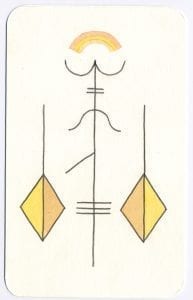
Jesse Bransford, Hills Become the Sun, 2015, Watercolor and graphite on paper, 4 x 6 1/2”
The easiest access to the works presented are to realize that all magic practice involves three active categories:
Verbal: A series of vocalizations, sometimes intelligible, often in alternate languages or pure vocalizations. The project’s title, Nomina Magica (Latin: magical names) recognizes and draws attention to the possible powers of words, names, and speech.
Somatic: The body used as a vehicle for magical energies, usually in the form of ritual postures (e.g. yoga). These postures activate actual space and ground the event/ritual in the place of the ritual. Both the artist and viewer are intended to be implicated in this dynamic.
Material: The theory of correspondences states that every thing has a symbolic meaning or lateral relation. Blood is akin to fire, for example. Every material can be likened to another thing or idea. The materials deployed to ends in this exhibition operate on many levels: color, tone, and form, as well as sign, symbol, and metaphor.
Recognizing the historically charged and magical aura of Seligmann’s farm, Bransford has not only made art objects that function magically, but is also explicitly making magical gestures that function artistically. If successful, the overall installation creates a series of spaces, portals, and windows into other ways, magical ways, of experiencing art.
Jesse Bransford is a Brooklyn-based artist whose work is exhibited internationally at venues including The Carnegie Museum of Art, the UCLA Hammer Museum, PS 1 Contemporary Art Center, and the CCA Wattis Museum, among others. He holds degrees from the New School for Social Research (BA), Parsons School of Design (BFA), and Columbia University (MFA). An associate professor of art at New York University and the chair of the Department of Art and Art Professions, Bransford’s work has been involved with belief and the visual systems it creates since the 1990s. Early research into color meaning and cultural syncretism led to the occult traditions in general and the work of John Dee and Henry Cornelius Agrippa specifically. He has lectured widely on his work and the topics surrounding his work and is the co-organizer of the biennial Occult Humanities Conference in New York. Work can be seen cataloged at http://jesse-bransford.blogspot.com/
Identity & Anonymity
Curated by Jonathan Talbot
June 19 - July 23, 2016
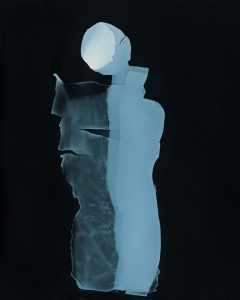
Claire Gilliam, The Blue Woman VI, Gelatin Silver Photogram toned with Iron, 16” x 20” 2015
Each of the works in the exhibition explores identity and/or anonymity from a different point of view. There are works which examine duplicity of identity, anonymity by context, the irrelevance of identity, gender-based anonymity, surrogate identities, anonymity of subject, the interface of identity and anonymity, and stereotypical identities.
The opening of the exhibition will also celebrate the publication of Identity & Anonymity –An Artful Anthology, a new book edited by Talbot, Fandrich, and Specht. This book, an outgrowth of the exhibition, includes contributions by Judy Chicago, Peter Coyote, Madelyn Greco, The Guerilla Girls, Janet Hamill, Dan Mack, Andrew Marvick, Thelonius Tinker, and many more.
Jonathan Talbot: Collage/Paintings
May 1 - June 12, 2016
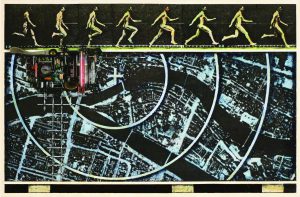
Jonathan Talbot, The Malthusian Perspectometer, Mixed Media
While Talbot has exhibited extensively throughout the U.S. and abroad, this will be his first solo show in Orange County in more than twenty years. The exhibition will be installed in the former studio of noted surrealist Kurt Seligmann. “This is a hallowed space,” says Talbot. “Not only because of the unique energy Seligmann brought to it, but also because it was visited by Marcel Duchamp, Kay Sage, Yves Tanguy, Max Ernst, Alexander Calder, Marc Chagall, and so many other outstanding 20th Century artists. To walk in their footsteps is a privilege. The Citizens Foundation is to be commended for preserving the exceptional artistic heritage of the Seligmann homestead.”
Included in the exhibition will be collage/paintings from Talbot’s Patrin Series and from his new Leturgy Series. Also on display will be collages from the artist’s Bachelor’s Series, created in response to Duchamp’s “La mariée mise à nu par ses célibataires, même,” as well as a number of uncategorized works.
By Chance: New Work by Lisa Breznak, Mimi Czajka Graminski & Riva Weinstein
June 20 - August 8, 2015
Lisa Breznak is a sculptor living and working in Peekskill, New York. Using a variety of material and patinas for surfacing on clay and recycled material, her anthropomorphized forms address universal issues of the human condition and the natural world. Breznak exhibits internationally and has had residencies in the United States and Japan, and a solo exhibition at the Hudson River Museum, New York. She has lectured on her work at Seika University Kyoto Prefectural University, and the Kyoto International Group, Japan, the Dorsky Museum, and Exit Art in New York City. She was a NYFA Fellow in the 2008 Mark Artists program and is the recipient of two NYFA Special Opportunity Stipends. Breznak holds degrees from Rochester Institute of Technology, SUNY, and Goddard College. http://www.lisabreznak.com/
Mimi Czajka Graminski juxtaposes unusual materials with traditional hand crafts, bringing new meaning to both. She has exhibited work nationally at venues that include Pratt/ Munson Williams Proctor Gallery, Abecedarian Gallery, Samuel Dorsky Museum, Islip Museum, Katonah Museum, and Sam Houston University Gallery, the Center for Curatorial Studies, Bard College, Exit Art, Lubbock Fine Arts Center, and Haggin Museum. Graminski’s work in Love of Art at The Hat Factory, New York was highlighted in the New York Times. She has received numerous awards including a NYFA Mark Fellowship, a NYFA Mark Consultancy Fellowship, a NYSCA grant, a Re-Arting Troy Grant for public art installation, and a New York Special Opportunity Stipend. Graminski lives and works in Red Hook, New York. http://mimigraminski.blogspot.com/
Riva Weinstein creates site specific performances and installations using every day experiences and materials. Weinstein has exhibited work throughout the Hudson Valley, New York City, Los Angeles, and New Zealand. Her work has been exhibited at venues including Exit Art and the Dorsky Museum and has work in the permanent collection of the Smithsonian Museum. She has received awards for her use of reclaimed materials, and presented workshops at the Omega Institute for Holistic Studies. She holds an MFA in Interdisciplinary Arts from Goddard College. http://rivaweinstein.com/
Katarina Riesing: Laws of Sympathy
January 10 - March 15, 2015
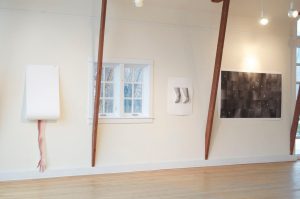 Katarina Riesing is a multi-media artist working in photography, drawing, video, and fiber. She holds a BA from Smith College and an MFA from the University of Wisconsin – Madison. Her work has been exhibited in New York, Oregon, Tennessee, Wisconsin, Massachusetts, and Berlin, Germany. Riesing is currently an assistant professor in Foundations Art at Alfred University in Alfred, New York. She lives and works in western New York. katarinariesing.com
Juanita Guccione: Defiant Acts
September 13 - November 1, 2014
Presented in partnership with Weinstein Gallery of San Francisco, California
Juanita Guccione (1904-1999) is one such artist whose work - and life - mirrored the radically creative and philosophical underpinnings of Surrealism. After a childhood in Massachusetts and Brooklyn, Guccione became a fashion model in New York City in the 1920s; rather than falling into the romantic role of ‘muse,’ she studied at the Art Students League before venturing to France, Italy, and Greece, supporting herself through portrait commissions. From there she sailed to Egypt, eventually settling in 1931 in Bou Saada, an artists’ colony in Algeria, amongst the Ouled Nail tribe. Traveling among Bedouin nomads in the Sahara, she produced a diverse oeuvre of portraits and landscapes that in 1935 would be exhibited at the Brooklyn Museum, alongside works by Jackson Pollock and Mark Rothko. After the birth of her son in 1934, Guccione returned to New York, designing murals with David Alfaro-Siqueiros for the Works Progress Administration and studying for seven years with Hans Hofman. Guccione infused social realism, cubism, surrealism, and abstraction with her own indefinable and audacious style, creating an independent mythology and challenging social conventions in her art and life. Women populate her canvases in wonderland environments, alongside animals, architecture, and fantastical landscapes, at times hinting to world events, other times mystic explorations. The writer and poet Anais Nin said of Juanita, “Few people can paint the world of our dreams with as much magic, precision and clarity.” Guccione’s work continued to evolve and elude the interpretations of critics worldwide - ultimately to her peril, as her name and art fell into relative obscurity.
The art critic Michael Welzenbach of the Washington Post writes that Guccione’s “single-minded approach to her work, (her) willingness to follow its development wherever that might lead… locates (her) squarely among the few but formidable ranks of the modernist avant-garde - a group whose integrity and vision will not be seen again in this century.”